
Back-to-back Accelerometer Calibration
April 6, 2026
Calibrating Accelerometers
Back to: Calibrating a Piezoelectric Accelerometer in VibrationVIEW
Laboratories can perform calibration internally or send their sensors to the manufacturer or a third party. Regardless of where the calibration takes place, the most common method and the focus of this course is the back-to-back method. Other methods include random vibration accelerometer calibration and close proximity accelerometer calibration.
To calibrate a vibration accelerometer is to accurately determine its sensitivity (in mV/g or pC/g) at various frequencies of interest. The ISA-approved back-to-back comparison method is a convenient and inexpensive technique.
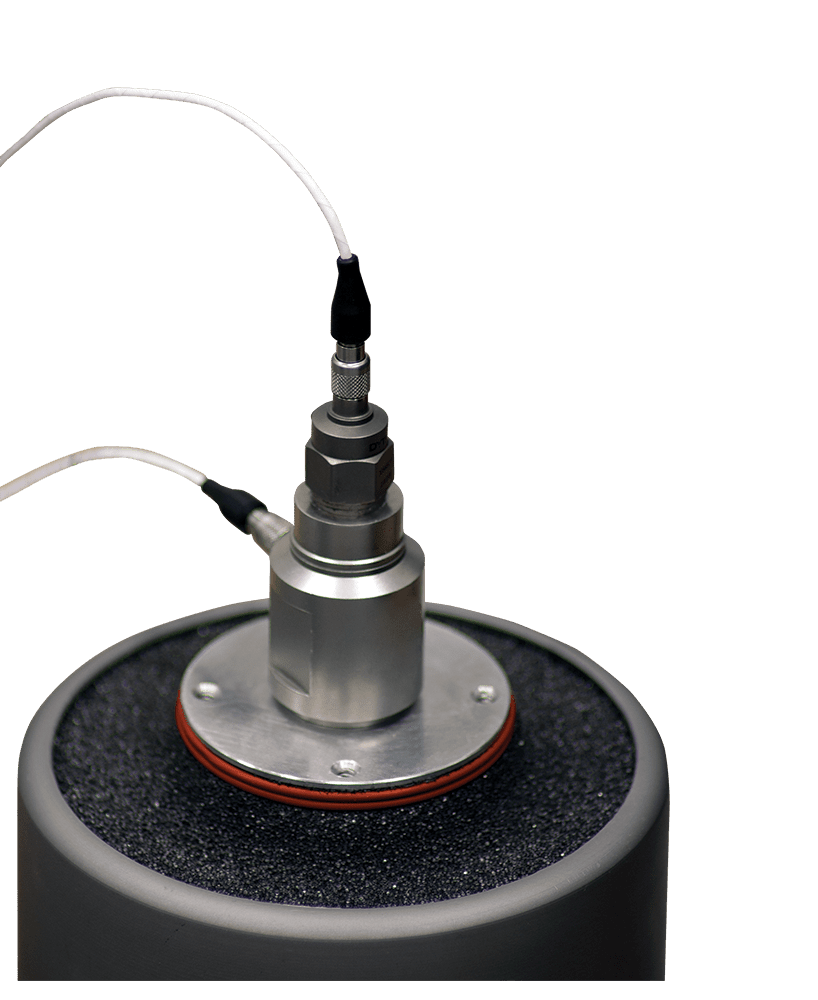 Typically, back-to-back calibration couples the test accelerometer directly to an NIST-traceable, double-ended calibration standard accelerometer. It drives the couple pair with a vibration shaker at various frequencies and acceleration (g) levels.
The assumption is that since the accelerometers are tightly coupled, both will experience the same motion. Thus, the calibration of the back-to-back standard accelerometer can be “transferred” to the test accelerometer [1]. The useful frequency range using this method is 10 Hz to 10,000 Hz and ±2%.
Vibration Research Calibration Package
Vibration Research offers a turn-key system that gives users the ability to perform calibrations within their facility. The average cost to send a sensor for calibration can add up quickly for a lab with many accelerometers.
With the VR setup, there is no limit to the number of accelerometers that can be calibrated and no recurring cost. The process is automated and takes less than 5 minutes per sensor. The user can create a custom profile or use the standard built-in profile.