
Accelerometer Calibration: Limits & Considerations
April 6, 2026
Calibrating Accelerometers
Back to: Calibrating a Piezoelectric Accelerometer in VibrationVIEW
Accelerometers are electromechanical devices that measure acceleration. Engineers them for applications such as modal analysis, environmental stress screening (ESS), health and usage monitoring systems (HUMS), predictive maintenance (industrial monitoring), and vibration testing. A vibration technician may encounter several hundred accelerometers in a day if conducting high-channel-count vibration tests.
Why Calibrate Accelerometers?
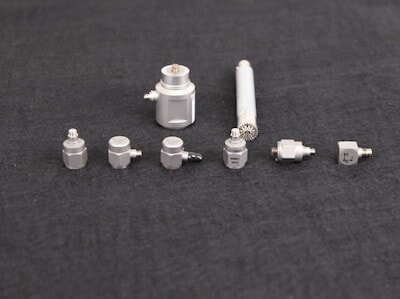
Accelerometers vary in physical size, weight, color, shape, and application, but all must be calibrated regularly to ensure the accuracy of the measured data.
Calibrations are generally acceptable for a one-year term. Accelerometers should be routinely calibrated throughout their service life.
Limitations & Considerations
When discussing limitations associated with certain accelerometers, it is important to make the distinction between dynamic and static measurements.
A static measurement is a physical quantity that is being measured; it changes very slowly or not at all. An example of a static measurement is gravity. If you were to measure gravity today and then again tomorrow, the measurement would be the same. Gravity is not something we have to check each morning to be sure that we can keep both feet on the ground.
The opposite of a static measurement is a dynamic measurement. By definition, a dynamic measurement is a physical quantity that changes rapidly over time. Examples include acceleration, force, and pressure.
When we discuss accelerometer calibration, we are referencing dynamic measurements. Engineers should understand this difference and the limitations that result from the nature of dynamic measurements. Sensitivities vary across the frequency range, and there is an element of uncertainty associated with the process.
Sensor Resonance
An accelerometer is a spring-mass system. By definition, every spring-mass system has a resonance. While an accelerometer is used to determine the resonant frequencies of products, the engineer must also consider its own resonant frequency.
The high-frequency response limit of a sensor is a function of its resonance. Most accelerometer manufacturers include sensor resonance on their data sheet. A general rule of thumb is to select an accelerometer with a resonant frequency at least 5x the highest frequency you are measuring.
For example, if an accelerometer has a resonant frequency of over 32 kHz, and the technician needs to calibrate up to 5 kHz, this value is within the general guideline of 5x, and the calibration values can be trusted.
Other Considerations
Some considerations when conducting accelerometer calibrations include temperature, noise, and electrostatic fields. Temperature should be consistently monitored for accuracy and included on any calibration certification related to a sensor. Noise within the laboratory should be minimized. Sensors can pick up noise and introduce it into the readings, which adds to the calibration uncertainty. Electrostatic energy should also be minimized to increase accuracy.
Several other error sources include pressure, poor cable or sensor attachment, and system ground loops. Engineers should consider each of these items and reduce them to the lowest level possible for the most accurate calibration procedure.
Accelerometer Error Sources
- Signal conditioning
- Cable disconnects
- Temperature
- Pressure
- Sound
- Force
- Base strain
- Gravity
- Centrifugal force
- Magnetic fields
- Electrostatic fields
- Poor attachment
- Ground loops
- Sensor resonace
- Accelerometer bracket resonance
- Mounting device(s) natural frequency
TEDS
VibrationVIEW can read and rewrite a sensor’s transducer electronic data sheet (TEDS). If a sensor has TEDS capability, the engineer can connect the sensor to the controller and prompt the software to read TEDS. The controller will send a signal to the accelerometer and automatically retrieve the correct sensitivity, manufacturer, model number, etc. The TEDS technology minimizes error when entering sensitivities and saves time by eliminating the search for the correct sensor calibration certificate.