Pyroshock (Pyrotechnic Shock) SRS Shaker Testing
May 22, 2026
Introduction
Control & Analysis
Industry Applications
Back to: Shock Response Spectrum (SRS)
Pyroshock testing simulates a component’s response to pyrotechnic events or explosive loading that occur in real-life applications such as stage separation or deployment mechanisms. These events are characterized by high peak accelerations, short durations, and high-frequency content.
Pyroshock simulation aims to generate a waveform that achieves the demand shock response spectrum (SRS). Due to the severity of pyrotechnic events, the effects can be far-reaching but differ as the shock propagates through the structure. The response attenuates, and the frequency content changes with distance from the source.
For this reason, engineers often use “near-,” “mid-,” and “far-field” to describe the general position of the component under test relative to the pyrotechnic event. Different simulation methods may be required for each region.
“If there is a question about the hardware susceptibility to pyroshock, then pyroshock testing shall be performed.” – NASA-STD-7003
Simulation Methods
Components closest to the pyroshock source (near-field) experience higher excitation levels than those at a distance. Near-field environments require mechanical impact or pyrotechnic simulation techniques to achieve the necessary high-frequency content (up to 10 kHz).
The effect of a pyrotechnic event can be so severe that engineers do not position components susceptible to high-frequency excitation in the near-field. However, these components may still incur damage from the attenuated shock waves. Engineers can use a shaker or mechanical excitation to generate short-duration transient motion that simulates shock waveforms experienced by many mid-field and most far-field components.
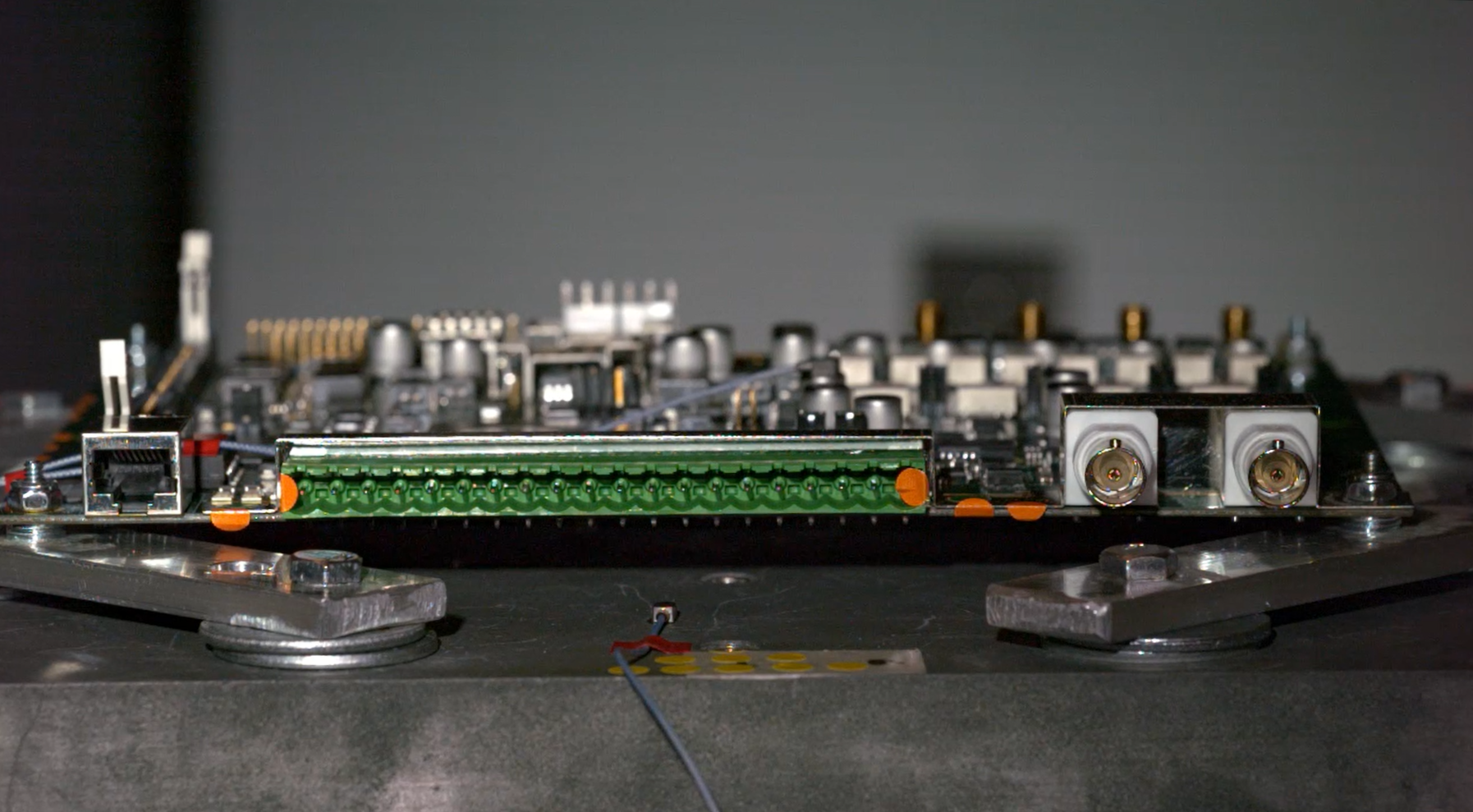
Pyroshock events often affect components with high natural frequencies, such as small electronics and lightweight components.
To determine which method to select, engineers must consider:
- Propagation distance from impact site
- Structural attenuation of final product
- Frequency content of attenuated waveform
- Achievable control bandwidth of test system
- Fixture dynamics relating to resonance and transmissibility
- Test standard requirements
Pyroshock SRS Shaker Testing
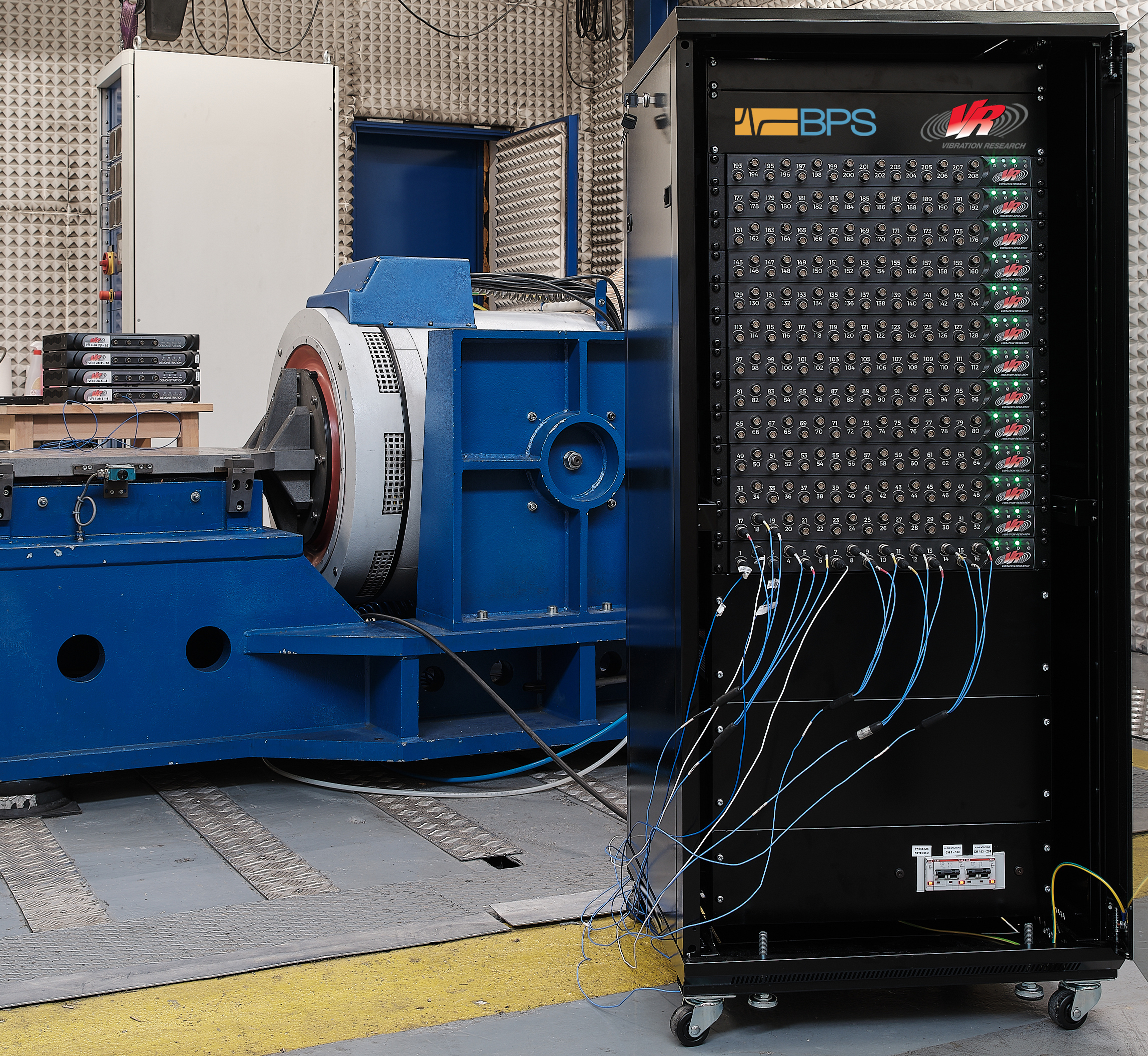
An example shaker system setup.
Shaker SRS testing is an acceptable method of pyroshock simulation for far-field components, particularly during early qualification testing. Properly defined shaker tests produce consistent, repeatable results that simplify test correlation and reduce test variability, which is particularly beneficial when repeating the same test profile on each axis.
An engineering team may choose to perform initial tests on a shaker to reduce risk to the payload and gather baseline data. Repeating a shaker test is simpler than performing multiple firings of a pyroshock event, and many test laboratories have a shaker system for sine and random testing.
Pyroshock tests are qualified by the damage potential of the resulting SRS compared to that of the actual pyroshock event. Shaker control systems like VibrationVIEW can perform SRS testing to meet standard requirements.
- Accurate closed-loop control of short-duration transients
- Adjustable safety margins and tolerance limits
- Test synthesis using measured flight or field data
- Data recording for waveform and SRS analysis
Electrodynamic shakers may not reproduce the highest-frequency near-field environments, but they remain effective for many controllable mid-field and far-field SRS simulations. It is important to note that many standards require pyrotechnic or mechanically induced shock testing at the assembly level to meet requirements.